Overview
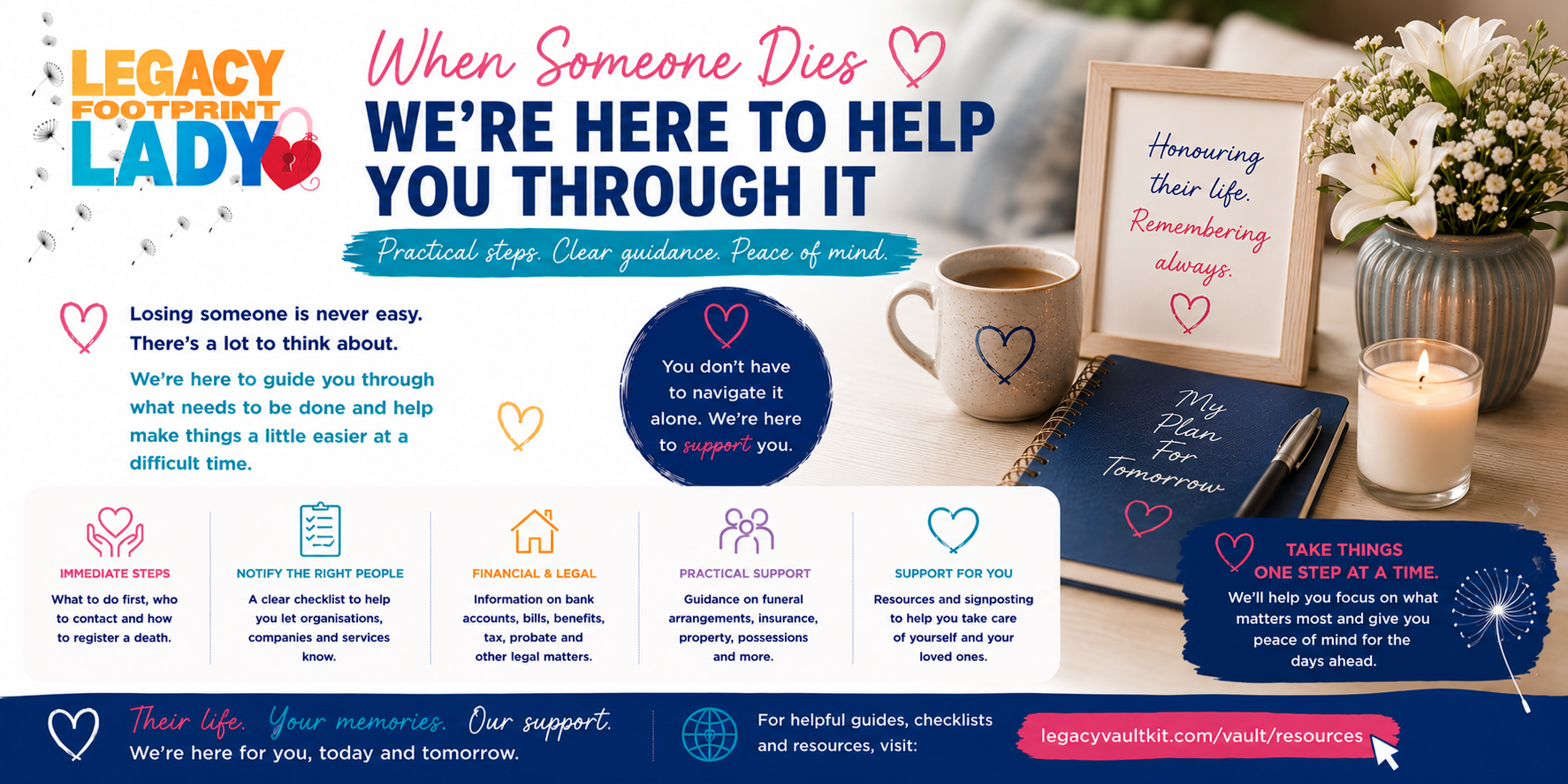
When someone dies, there is a great deal to think about and organise at a time when you are already grieving. It can feel overwhelming. This guide breaks everything down into clear, manageable steps — what to do immediately, what can wait a few days, and what to tackle over the coming weeks. You do not have to do everything at once. Take it one step at a time.
Why This Matters
Having a clear checklist of what needs to be done after a death means you do not have to try to remember everything at a time when your mind is elsewhere. It also helps to share the tasks between family members so no one person carries the burden alone. The more information the deceased left in a safe place — such as Legacy Vault Kit — the easier this process will be for everyone.
Key Facts
- A death must be registered within 5 days in England and Wales (8 days in Scotland).
- You will need multiple certified copies of the death certificate — buy at least 4 to 6 at registration.
- The Tell Us Once service notifies multiple government departments at once after registration.
- Banks and financial institutions will freeze accounts as soon as they are notified.
- Most banks will release funds for funeral costs before probate is granted.
- If there is a will, the executor is responsible for administering the estate.
- If there is no will, the estate is distributed according to the Rules of Intestacy.
- Grief support is available — you do not have to manage alone.
Step by Step
- 1
In the first 24 hours
If the death was expected at home, contact the GP or out-of-hours doctor to certify the death. If the death was unexpected, call 999. If the death occurred in hospital, the hospital will guide you through the next steps. Contact close family and friends. You do not need to do anything else immediately — give yourself time.
- 2
Arrange the funeral
Contact a funeral director as soon as you feel ready. They will guide you through the process and help you make arrangements. If the deceased left funeral wishes — for example, in a Legacy Vault Kit — share these with the funeral director. The funeral cannot take place until the death has been registered and the green form has been issued.
- 3
Register the death
Register the death at the local Register Office within 5 days. You will need the Medical Certificate of Cause of Death from the doctor. The registrar will give you the death certificate and the green form for the funeral director. Buy at least 4 to 6 certified copies of the death certificate at this point.
- 4
Notify the right people
Use the Tell Us Once service to notify government departments. Then contact: the deceased's bank and financial institutions, their employer or pension provider, their insurance companies, their landlord or mortgage lender, and any subscription services. Check bank statements for direct debits to identify all accounts.
- 5
Find the will and appoint an executor
Locate the will as soon as possible. The executor named in the will is responsible for administering the estate. If there is no will, the next of kin can apply for letters of administration. If you are not sure whether there is a will, check with the deceased's solicitor, bank, or the National Will Register.
- 6
Apply for probate if required
If the estate includes property or significant assets, you will likely need to apply for probate (or letters of administration if there is no will). This gives the executor legal authority to deal with the estate. Apply through the HMCTS probate service. A solicitor can help if the estate is complex.
- 7
Deal with the estate
Once probate is granted, the executor can collect the assets, pay any debts and taxes, and distribute the estate to the beneficiaries. This process can take several months. Keep clear records of everything you do as executor.
- 8
Look after yourself
Grief is not a process with a fixed timeline. Be kind to yourself and those around you. Practical tasks can feel relentless, but it is important to take breaks and accept help when it is offered. Grief support is available from organisations such as Cruse Bereavement Support, the Samaritans, and your GP.
Keep all your practical documents and notes in one secure place. Your family will know exactly where to look when it matters most.
Frequently Asked Questions
- What is the very first thing I need to do?
- If the death was expected, contact the GP or doctor to certify the death. If it was unexpected, call 999. After that, there is no rush — contact close family and give yourself time before thinking about practical matters.
- Do I need a solicitor?
- Not always. For straightforward estates — for example, where everything passes to a surviving spouse — you may be able to deal with everything yourself. For more complex estates, particularly those involving property, business interests, or disputes, a solicitor can be very helpful.
- What if I cannot find the will?
- Check the deceased's home, their bank's safe deposit box, their solicitor's office, and the National Will Register. If no will can be found, the estate is distributed according to the Rules of Intestacy, which sets out who inherits in what order.
- What is Tell Us Once?
- Tell Us Once is a free government service that lets you report a death to multiple government departments at once — including HMRC, the DVLA, the Passport Office, and the Department for Work and Pensions. The registrar will give you a unique reference number to use the service after you register the death.
- How long does probate take?
- A straightforward probate application typically takes 3 to 6 months from the date of application. More complex estates can take longer. During this time, most assets are frozen and cannot be distributed.
- Where can I get support with grief?
- Cruse Bereavement Support (cruse.org.uk) offers free support to anyone affected by grief. The Samaritans (samaritans.org) are available 24 hours a day. Your GP can also refer you to local bereavement counselling services. You do not have to manage alone.
Official Resources
These links go directly to official government and trusted organisation websites.
- What to do after someone dies — GOV.UKOfficial step-by-step guide to what needs to be done after a deathGOV.UK
- Tell Us Once serviceNotify multiple government departments about a death at onceGOV.UK
- Apply for probateApply for probate online through the official HMCTS serviceGOV.UK
- Cruse Bereavement SupportFree bereavement support for anyone affected by griefCruse
- Citizens Advice — what to do after a deathComprehensive guide to the practical steps after a deathCitizens Advice
- National Will RegisterSearch for a will registered with the National Will RegisterNational Will Register
How Legacy Vault Kit Can Help
Legacy Vault Kit is designed to make this process as easy as possible for the people you love. When everything is organised in one place — personal details, financial accounts, legal documents, funeral wishes, and important contacts — your family will know exactly what to do and where to find everything. The kindest thing you can do is to get organised today.