Overview
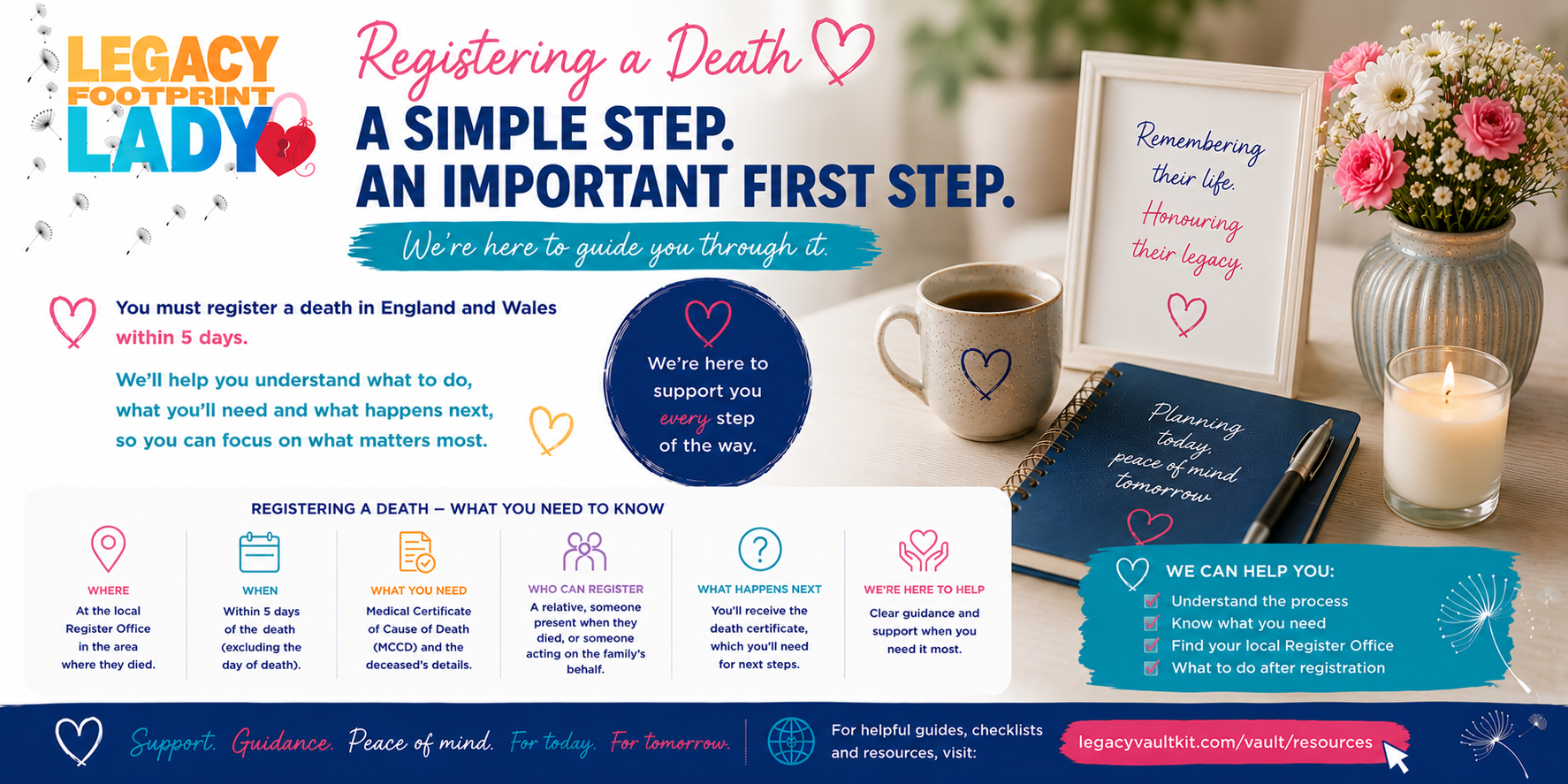
Registering a death is one of the first official steps after someone passes away. It must be done within 5 days in England and Wales (8 days in Scotland). The process is straightforward, but knowing what to expect and what to bring makes it much easier at what is already a difficult time. This guide walks you through everything you need to know.
Why This Matters
Without a death certificate, it is almost impossible to deal with a person's affairs — you cannot close bank accounts, claim benefits, arrange the funeral, or apply for probate. Registering the death promptly means your family can begin to move forward with practical matters. Keeping key personal information in your vault means the person registering will have everything they need to hand.
Key Facts
- In England and Wales, a death must be registered within 5 days (8 days in Scotland, 8 days in Northern Ireland).
- Registration must take place at the Register Office in the district where the death occurred.
- The death certificate is a legal document needed for almost every other step after a death.
- You can purchase multiple certified copies of the death certificate at the time of registration — it is cheaper than ordering them later.
- The registrar will give you a Certificate for Burial or Cremation (the green form) to give to the funeral director.
- The Tell Us Once service can be used after registration to notify multiple government departments.
- If the death has been referred to the coroner, registration may be delayed.
- You can register a death in person only — it cannot be done online.
Step by Step
- 1
Obtain the Medical Certificate of Cause of Death
Before you can register the death, you need the Medical Certificate of Cause of Death (MCCD). This is issued by the doctor who attended the deceased. If the death was sudden, unexpected, or the cause is unknown, the death may be referred to the coroner, which can delay registration.
- 2
Find your local Register Office
The death must be registered at the Register Office in the district where the death occurred, not where the deceased lived. Search for your local Register Office on GOV.UK. Most offices require an appointment, so call ahead or book online.
- 3
Gather the information you will need
You will need to provide: the full name of the deceased (including any previous names), their date and place of birth, their last address, their occupation, whether they were married or in a civil partnership, the name and date of birth of their surviving spouse or civil partner, and their NHS number if available. You do not need to bring a birth certificate or passport, but having them can help.
- 4
Attend the Register Office
Attend your appointment at the Register Office. The registrar will ask you questions about the deceased and record the information. They will check the Medical Certificate of Cause of Death. The appointment usually takes around 30 minutes.
- 5
Collect the documents you need
After registration, the registrar will give you: a Certificate for Burial or Cremation (the green form) to give to the funeral director, and a Certificate of Registration of Death (form BD8) for the Department for Work and Pensions. You can also purchase certified copies of the death certificate at this point. Buy at least 4 to 6 copies — you will need them for banks, insurers, solicitors, and other organisations.
- 6
Use Tell Us Once
After registration, you can use the Tell Us Once service to notify multiple government departments at once, including HMRC, the DVLA, the Passport Office, and the Department for Work and Pensions. The registrar will give you a unique reference number to use the service.
Keep all your practical documents and notes in one secure place. Your family will know exactly where to look when it matters most.
Frequently Asked Questions
- Who can register a death?
- A relative of the deceased is the first choice. If no relative is available, the following can register: someone present at the death, the occupier of the building where the death occurred, the person arranging the funeral (but not the funeral director), or the executor named in the will.
- What if the death has been referred to the coroner?
- If the death is referred to the coroner — for example, if the cause is unknown, the death was sudden or unexpected, or the deceased had not seen a doctor recently — the coroner must complete their investigation before the death can be registered. This can take several weeks. The coroner will issue a certificate when they are satisfied, allowing registration to proceed.
- How many death certificates do I need?
- You will typically need one certified copy for each organisation that requires an original. Common requirements include: the bank, each financial institution, the solicitor dealing with probate, the insurance company, the pension provider, and the mortgage lender. Buying 4 to 6 copies at registration is much cheaper than ordering them later.
- Can I register a death in a different district?
- You can make a declaration at any Register Office in England and Wales, but the death will be registered by the Register Office in the district where it occurred. This is called registering by declaration. It takes a little longer but means you do not have to travel to the district where the death occurred.
- What is the green form?
- The Certificate for Burial or Cremation (known as the green form) is issued by the registrar after registration. It authorises the funeral director to proceed with the burial or cremation. Without this form, the funeral cannot take place. If the death has been referred to the coroner, the coroner will issue a different form.
- What happens if I miss the 5-day deadline?
- You should register as soon as possible. If there is a valid reason for the delay — for example, the death was referred to the coroner — this will be taken into account. Contact your local Register Office if you are concerned about the deadline.
Official Resources
These links go directly to official government and trusted organisation websites.
- Register a death — GOV.UKOfficial guidance on how and where to register a death in England and WalesGOV.UK
- Find your local Register OfficeSearch for the Register Office in the district where the death occurredGOV.UK
- Tell Us Once serviceNotify multiple government departments about a death at onceGOV.UK
- What to do after someone dies — GOV.UKStep-by-step guide to what needs to be done after a deathGOV.UK
- Citizens Advice — registering a deathPlain-English guide to registering a death from Citizens AdviceCitizens Advice
How Legacy Vault Kit Can Help
Legacy Vault Kit has a Personal section where you can store key information that will be needed to register a death — including full name, date and place of birth, NHS number, last address, and occupation. Keeping this information in your vault means the person registering the death will have everything they need to hand, without having to search through paperwork at an already difficult time.