Overview
Inheritance tax (IHT) is a tax on the estate of someone who has died. It is one of those topics that many people put off thinking about — but understanding the basics can help you plan ahead and potentially reduce the amount your family has to pay. This guide explains the key rules in plain English, with links to the official HMRC guidance.
Why This Matters
Without some basic planning, your family could face an unexpected tax bill at an already difficult time. Many people assume inheritance tax only affects the very wealthy — but with rising property values, more estates are now above the threshold. Understanding what applies to your situation means you can make informed decisions while you are still able to.
Key Facts
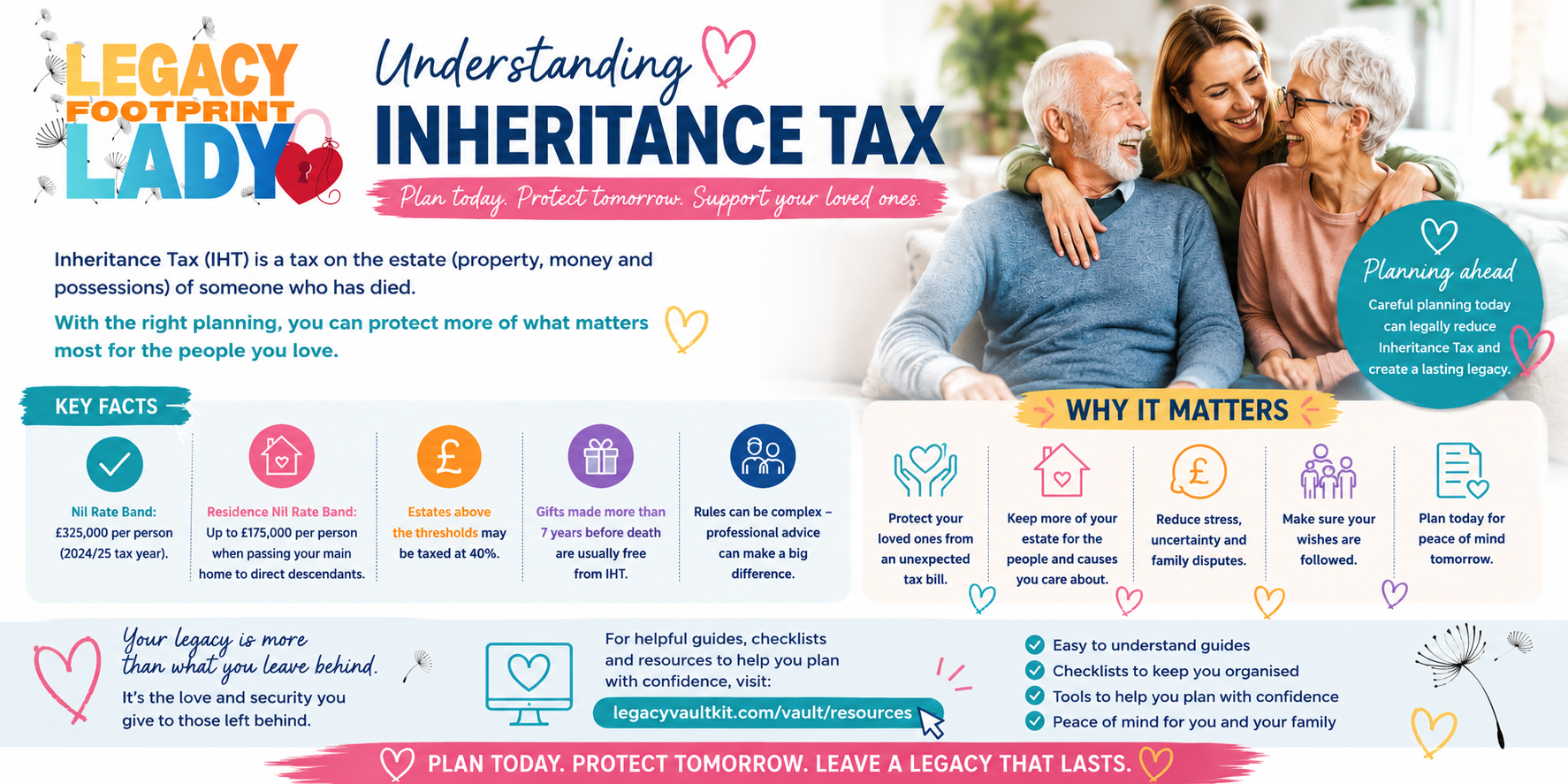
- The standard inheritance tax threshold (nil-rate band) is £325,000 per person.
- Anything above the threshold is taxed at 40%.
- Married couples and civil partners can combine their allowances, giving a potential £650,000 threshold.
- The residence nil-rate band adds up to £175,000 if you leave your home to direct descendants.
- Gifts made more than 7 years before death are usually exempt from inheritance tax.
- Gifts to a spouse or civil partner are always exempt, regardless of amount.
- Charitable donations are exempt from inheritance tax.
- Business and agricultural assets may qualify for relief.
- The estate has 6 months from the end of the month of death to pay any inheritance tax due.
Step by Step
- 1
Understand your current threshold
The basic nil-rate band is £325,000. If you are married or in a civil partnership and your spouse did not use their full allowance when they died, you may be able to transfer it. If you plan to leave your home to children or grandchildren, you may also qualify for the residence nil-rate band of up to £175,000.
- 2
Estimate the value of your estate
Add up the approximate value of everything you own: property, savings, investments, pensions, life insurance, vehicles, jewellery, and other assets. Subtract any debts and funeral costs. This gives you an estimate of your taxable estate.
- 3
Consider gifts during your lifetime
You can give away up to £3,000 per year free of inheritance tax (the annual exemption). Gifts to individuals are usually exempt if you survive for 7 years after making them. There are also specific exemptions for wedding gifts, small gifts, and regular gifts from income.
- 4
Think about your will
A well-drafted will can help ensure your estate passes as tax-efficiently as possible. Leaving assets to a spouse or civil partner is always exempt. Leaving a portion to charity can reduce the rate of inheritance tax on the rest of your estate from 40% to 36%.
- 5
Consider life insurance written in trust
A life insurance policy written in trust pays out directly to your beneficiaries and does not form part of your estate. This means the payout is not subject to inheritance tax and reaches your family more quickly.
- 6
Take professional advice if needed
Inheritance tax planning can be complex, especially for larger estates, business owners, or those with assets in multiple countries. A qualified financial adviser or solicitor who specialises in estate planning can help you understand your options.
- 7
Record everything in your vault
Write down the approximate value of your estate, any gifts you have made, and any planning steps you have taken. This information is invaluable for your executors and family when the time comes.
Keep all your financial documents and notes in one secure place. Your family will know exactly where to look when it matters most.
Frequently Asked Questions
- Does everyone pay inheritance tax?
- No. Most estates do not pay inheritance tax. Only estates worth more than the nil-rate band (currently £325,000, or more with additional allowances) are subject to it. According to HMRC, only around 4% of deaths result in an inheritance tax bill.
- What is the 7-year rule?
- If you give money or assets to someone and survive for 7 years after making the gift, it is usually exempt from inheritance tax. If you die within 7 years, the gift may be subject to tax, but the rate reduces on a sliding scale (known as taper relief) after 3 years.
- Is my pension included in my estate for inheritance tax?
- Most defined contribution pension pots are currently outside your estate for inheritance tax purposes, which makes them a tax-efficient way to pass on wealth. However, the rules are changing from April 2027, when unspent pension pots will be included in the estate. It is worth reviewing your pension nominations now.
- What is the residence nil-rate band?
- The residence nil-rate band (RNRB) is an additional allowance of up to £175,000 that applies when you leave your main home to direct descendants such as children or grandchildren. Combined with the standard nil-rate band, a single person could potentially pass on up to £500,000 tax-free, or £1 million for a married couple.
- Do I need to pay inheritance tax if I inherit from a spouse?
- No. Assets passed between spouses or civil partners are always exempt from inheritance tax, regardless of the amount. You also inherit any unused nil-rate band allowance from your spouse, which can be used when you die.
- What happens if I own property abroad?
- If you are domiciled in the UK, your worldwide assets are subject to UK inheritance tax, including overseas property. If you are not UK-domiciled, only your UK assets are subject to it. Expats should take specialist advice as the rules around domicile can be complex.
Official Resources
These links go directly to official government and trusted organisation websites.
- Inheritance Tax overview — GOV.UKOfficial HMRC guidance on inheritance tax thresholds, rates, and exemptionsGOV.UK
- Gifts and inheritance taxRules on gifts, the 7-year rule, and annual exemptionsGOV.UK
- Residence nil-rate bandHow the residence nil-rate band works when leaving your home to descendantsGOV.UK
- MoneyHelper — Inheritance Tax guideFree, impartial guidance on inheritance tax planningMoneyHelper (UK)
How Legacy Vault Kit Can Help
Legacy Vault Kit has a Financial section where you can record the approximate value of your estate, any gifts you have made, and any inheritance tax planning steps you have taken. You can also store copies of your will and any trust documents. When your Trusted Person or executor needs this information, it will all be in one place.